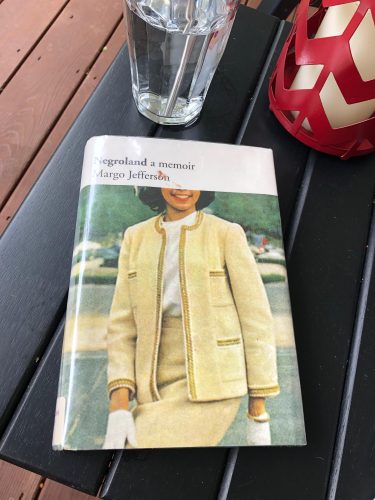
Negroland a memoir by Margo Jefferson
3 of 5 stars
Mixed feelings on this memoir. Another one that I don’t remember where I heard about it but added it to my list of books to read.
I’m reading the book from a place of white privilege obviously but I learned a great deal. There is a great discussion in the book of the racism that is America. She speaks of her family trying to act white but not too white. Never fitting in with other lower-class blacks and not fitting in with whites either. Being on the radar of whites but being careful to better themselves but not too much.
I also feel ashamed. Why do we treat each other this way?
I didn’t find it written well at all. Bad grammar and bad punctuation. There were sentences that didn’t have any punctuation. Some of it was written like poetry. Some written like text. Entire paragraphs in italics. I couldn’t quite figure it all out. Where was the sense in it all? It was all over the place. Like you walked into a conversation mid-conversation and you were never able to contribute because you had no idea where the author was going or what the hell she was talking about. When it was good it was good but when it was bad it was bad. She was trying to teach a history lesson mixed in with her memoir; which is fine but the way she went about it was hard to comprehend sometimes.
Why did the book win so many awards? Is it because she talked about race? Is it because she talked about a different class of blacks we aren’t used to hearing about? Read some of the other Goodreads reviews. They agree with me on how disjointed the book is.
There is so much history of courageous men and women in this memoir that I loved learning about. The list of names I wrote down to do more research on begins with names like James Forten, Frances Jackson Coppin, Cyprian Clamorgan, Charlotte Forten, Ida B. Wells, Anna Julia Cooper, and many more.
Some passages really affected me.
From page 32: In speaking of Anna Julia Cooper: “Like so many women’s rights leaders she insists on believing women possess sympathies and spiritual gifts men lack. But – and here she becomes a tough-minded political pragmatist – women cannot reform society without working to educate themselves. And white women can reform nothing until and unless they are willing to relinquish their caste privilege, those codes of racial and social superiority they extol in their men and instill in their children.”
From page 43: Margo’s mother, when asked if they were upper class, “We’re considered upper-class Negroes and upper-middle-class Americans but most people would like to consider us Just More Negroes.”
From page 96: She speaks about other perceived lower-class Negro children moving into the neighborhood she lived in bringing in a culture she knew nothing about. Her parents then decided it was time to move again. Better to be upper-class Negro in a white neighborhood than upper-class Negro in a black neighborhood.
From page 114: Margo writes of family members that pass for white. “He was a former white man. And my parents looked down on him a little. Not because he’d passed, but because he’d risen no higher than a traveling salesman. If you were going to take the trouble to be white, you were supposed to do better than you could have done as a Negro.”
It was definitely worth the read but overall I didn’t like the style it was written in.
VIDEOS
Brown University’s Inside Negroland
ABOUT NEGROLAND







Leave a Reply