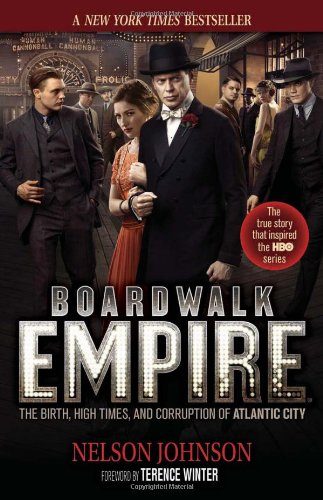
Boardwalk Empire: The Birth, High Times, and Corruption of Atlantic City by Nelson Johnson
3 1/2 stars out of 5
I don’t gamble. I’ve never been to Atlantic City. I hated Vegas the one time I went. Why did I read this book then? Because I loved the HBO series of the same name. I’m a sucker for stories set during the 20s-30s, gangsters, flappers, and jazz. As a history buff it is one of my favorite times in history. HBO did a marvelous job of the series. You should watch it. Fine, fine acting, costumes, and set design.
The book was not about the history of the TV series but the TV series was based on this book. Johnson spent 20 years reasearching this book!
I really felt like it went very in-depth into the history of Atlantic City from beginning to current time. What fascinated me most about the book was not how interested I was in Atlantic City itself but the more social and anthropological history of how it came to be and what made it successful and what made it fail.
Yes, there is a lot of political and gangster history that I kind of skimmed over but he really covered everything into what made this city tick. Architecture. Streets/planning design. The African-American culture. Women’s history. Prohibition. Voting rights. How the weather shaped the city.
There was just so much packed into this book. I thought it was going to be just about gangsters but it was so much more. There is even an interesting chapter about how our current President shaped the city with his outrageous choices and business decisions.
Interesting tidbits about the author/book:
- About the Author
- Author Nelson Johnson strikes gold with infamous Atlantic City characters
- PBS State of the Arts – Nelson Johnson
- PBS One-on-One This Week: Historian and Author, Nelson Johnson
Here are some of the passages I highlighted that I found interesting:
History rarely marches in a straight line. Succeeding generations have a way of retrenching as they reject portions of social changes made earlier. Time and again, positive social advancements are made only to be followed by negative reactions.
That so many people in power could take leave of their senses by supporting a law so utterly unenforceable stands as a monument to the ignorance of single-issue politics. It’s the classic example of the “law of unintended consequences.” While Prohibition reduced the general availability of alcohol, it greatly increased the money available for political corruption and organized crime. Otherwise law-abiding citizens refused to give up the pleasure of an occasional drink and got their booze from illegal suppliers. An authority on Prohibition, Al Capone once said: I make my money by supplying a public demand. If I break the law, my customers, who number hundreds of the best people in Chicago, are as guilty as I am. The only difference between us is that I sell and they buy. Everybody calls me a racketeer. I call myself a businessman. When I sell liquor, it’s bootlegging. When my patrons serve it on a silver tray on Lake Shore Drive, it’s hospitality. Selling liquor unlawfully was nothing new in Atlantic City. Resort tavern owners had violated the state’s Bishops’ Law for years by serving drinks on Sunday. If they could get away with it one day a week, why not seven? “Prohibition didn’t happen in Atlantic City.” As far as Atlantic City was concerned, the 18th Amendment to the U.S. Constitution never existed. While other cities had speakeasies and private clubs, the sale of alcohol in the resort continued as usual in taverns, restaurants, hotels, and nightclubs. You could buy liquor in drugstores, the corner grocery, and the local farmer’s market. The resort was more than an outlet for illegal booze, it was a major port of entry for foreign-produced liquor. Large “mother ships,” bearing thousands of cases of whiskey and rum, anchored off the coast where they were greeted by speedboats, which were little more than empty hulls with twin motors. Cases of liquor were unloaded all along the island, with speedboats pulling into the bay near a city firehouse where they were greeted by the local firemen who helped unload the booze. “Everybody helped out. If you worked for the city you could count on one time or another working a night shift and being told to go to such and such place and help unload a boat. You weren’t supposed to know what it was but everybody did.”
The “Roaring ’20s” were golden years for both Nucky and his town. It was a gay place that reveled in its ability to show its visitors a good time. The liquor flowed and the party seemed as though it would go on forever. In the days before television and widespread home radio, the Boardwalk rivaled New York City’s Great White Way as a national showcase for promoting consumer products and introducing new entertainment figures and productions. During the decade between 1920 and 1930, the Boardwalk became known as the “Second Broadway” of the nation. A production didn’t go to New York until it first showed in Atlantic City. There were hundreds of Boardwalk theatrical tryouts with famous stage names that drew wealthy playgoers from throughout the entire northeast, many of them arriving in their own private railroad cars.
Without Black workers, Atlantic City would have been a very different place. Absent the cheap labor provided by Blacks, a tourist economy could never have developed and Jonathan Pitney’s beach village would have remained just that. Between the Civil War and World War I, America’s economy was exploding with job opportunities for Whites, both skilled and unskilled. Atlantic City couldn’t compete for White workers in the economy of the late 19th century. The nearest population center large enough to generate the required numbers of unskilled workers was Philadelphia. The expansion of that city’s industrial economy sucked up every able-bodied person and at wages greater than hotels could afford. There was no chance for Atlantic City’s hotels to attract the numbers of White workers needed for such menial work. The resort had no choice but to pursue Black workers. What none of the White hoteliers could foresee as they began recruiting Blacks was the extent to which their operations would come to rely upon them. Nor could the operators envision what a large presence they would have in the city. And, finally, the last thing business owners gave any thought to was how it would all play out in terms of social integration.
The migration of Southern Blacks to the urban North was traumatic for many of them. Stripped of the practices and social structures they had created in order to cope with their lowly status in Southern society, many felt lost in a strange land. Without the customs of the invisible church, these new migrants found it difficult to adjust to the tumult of urban life. The loss of the customary religious practices, which had been their only refuge during slavery, produced an ever-present crisis in the life of the average Black migrant. In order for the visible Black church to play the role needed by its followers, it had to be transformed. The transformation of the African-American church began with secularization. Black churches began to lose their other-worldliness and focused their energy on the conditions of their congregants in this world. Churches became increasingly interested in the affairs of the community as they impacted upon their members. Another transformation that occurred in Black religious behavior was the emergence of Holiness and Spiritualist churches. Originally formed as personality cults, their leaders had a message directed to the post-slavery experience. In Atlantic City, most such churches had their inception in storefronts, side-by-side with row houses and businesses. These storefront churches were usually located in the poorer neighborhoods and served the lower class, especially the newly arrived migrants from the South. As was the case in other Northern cities, storefront churches flourished because they adopted the rural church experience to city life by providing the face-to-face association of a small church. Their existence was due partly to the poverty of their members and the fact that congregants could participate more freely in services during prayers by “shouting.” The inability of the more traditional denominations to serve the needs of Black migrants stimulated the growth of storefront churches. These churches made it possible for Blacks to worship in a manner in which many had practiced in the South. Their religious rites were highly emotional, creating a personal form of worship in which all the members of the congregation became involved. Their pastors preached about a very real heaven and hell. Their church services appealed to those Blacks searching for relief from the insecurities of this world through salvation in the next.
From the time of the Civil War until the election of Franklin D. Roosevelt during the Great Depression, the overwhelming majority of Blacks who voted in this country voted Republican, the party of Abraham Lincoln. The presence of such a substantial minority, with a predictable voting pattern, made Atlantic City’s African-American population a pawn in Kuehnle’s rise to power. He exploited them for every vote he could.
SUMMARY FROM GOODREADS:
From its inception, Atlantic City has always been a town dedicated to the fast buck, and this wide-reaching history offers a riveting account of its past 100 years, from the city’s heyday as a Prohibition-era mecca of lawlessness to its rebirth as a legitimate casino resort in the modern era. A colorful cast of characters, led by Enoch “Nucky” Johnson, populates this stranger-than-fiction account of corrupt politics and the toxic power structure that grew out of guile, finesse, and extortion. Atlantic City’s shadowy past through its rise, fall, and rebirth is given new light in this revealing, and often appalling, study of legislative abuse and organized crime.
1






Leave a Reply