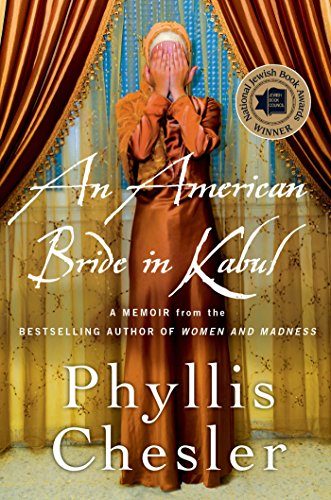
An American Bride in Kabul by Phyllis Chesler
2 1/2 stars out of 5
For me, I thought it needed to be fleshed out more. I wanted more detail. More history of why things are this way. Where does it stem from? I’m sure that is a longer book though.
She was only there 10 weeks so I don’t feel like that is long enough to warrant an in-depth analysis of life there. That’s not to say that her experience isn’t interesting but I want to know more details. She does stray from her time there and write about a little bit about what has happened since to her since, the ex-husband, etc. So, I guess it tells a little about what life there was like but not a lot because she wasn’t there a long time.
She alludes to the fact that it is different now and I think we know that from the media. They are going backward in time and not progressing. Do they want to progress? Maybe a little bit as a culture they do but they can’t because of current leadership under the Taliban. I just don’t know. It’s a very interesting topic to me that I’ve always been fascinated with. I can’t even sometimes wrap my head around what these men are so afraid of in women that they want them to wear burqas and be uneducated and pregnant.
Another reviewer on Amazon had this to say and I agree:
The second part of the book speaks to more varied topics and discusses Afghan Jews, 9/11, pro-Israeli thought, and discussion of Afghan culture from a feminist perspective. She argues that Afghanistan is a violent, tribal, medieval, Islamist (as distinct from Muslim) society. She believes that it is unacceptable to view Afghanistan through the lens of cultural relativism. Chesler was worked extensively with female victims of attempted honor killings, and she has written a book on the topic. I think that if one wants to read Chesler’s work, that’s probably the book to choose. It seems like many of the ideas she mentions in this book were developed through that work. I would like to read Chesler’s work where she uses a full academic apparatus (situates herself in existing literature and provides full notes), as some of her big, broad claims could really use that standard of context and proof.
SUMMARY FROM GOODREADS
Few Westerners will ever be able to understand Muslim or Afghan society unless they are part of a Muslim family. Twenty years old and in love, Phyllis Chesler, a Jewish-American girl from Brooklyn, embarked on an adventure that has lasted for more than a half-century. In 1961, when she arrived in Kabul with her Afghan bridegroom, authorities took away her American passport. Chesler was now the property of her husband’s family and had no rights of citizenship. Back in Afghanistan, her husband, a wealthy, westernized foreign college student with dreams of reforming his country, reverted to traditional and tribal customs. Chesler found herself unexpectedly trapped in a posh polygamous family, with no chance of escape. She fought against her seclusion and lack of freedom, her Afghan family’s attempts to convert her from Judaism to Islam, and her husband’s wish to permanently tie her to the country through childbirth. Drawing upon her personal diaries, Chesler recounts her ordeal, the nature of gender apartheid–and her longing to explore this beautiful, ancient, and exotic country and culture. Chesler nearly died there but she managed to get out, returned to her studies in America, and became an author and an ardent activist for women’s rights throughout the world. An American Bride in Kabul is the story of how a naive American girl learned to see the world through eastern as well as western eyes and came to appreciate Enlightenment values. This dramatic tale re-creates a time gone by, a place that is no more and shares the way in which Chesler turned adversity into a passion for world-wide social, educational, and political reform.







Leave a Reply